Inside the transformer: the decoder
Now let’s examine the decoder.
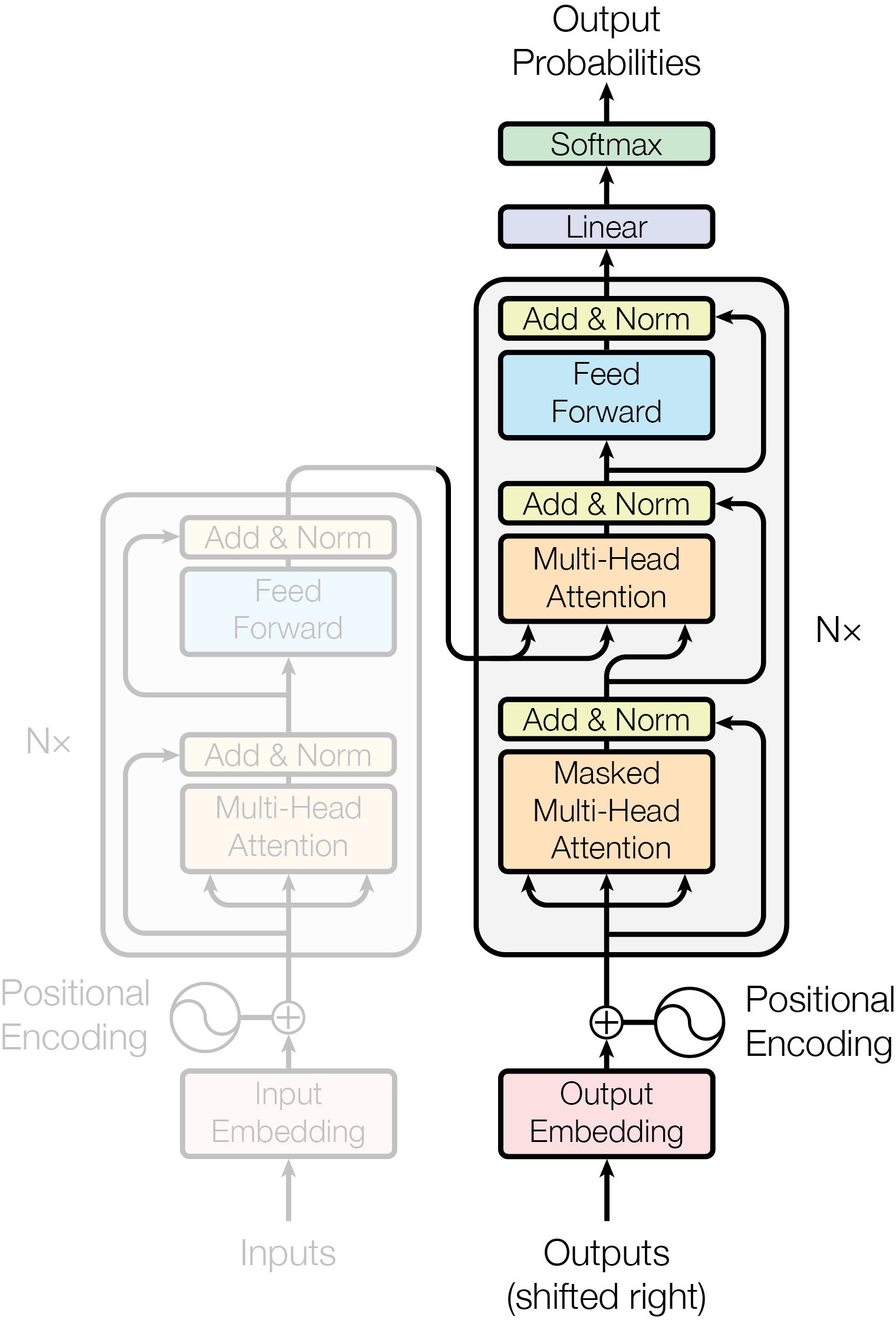
Vaswani et al., *Attention Is All You Need* (2017), Figure 1
Output embeddings
The decoder also converts tokens to vectors. The encoder receives the source sentence, while the decoder receives the beginning of the target translation.
Suppose “Ich trinke Kaffee” should translate to I drink coffee. During training, place a beginning-of-sequence token, <BOS>, before the target. The decoder input omits the final <EOS> token, while the prediction targets include it.
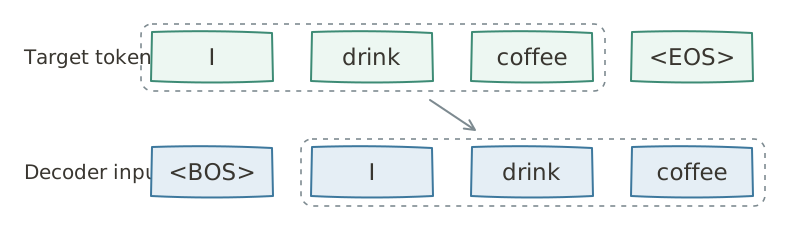
This is shifted-right input. <BOS> predicts I; <BOS> I predicts drink; <BOS> I drink predicts coffee; and the full prefix predicts <EOS>.
Target token IDs select embedding vectors through the output embedding table. “Output” refers to the target-language tokens, even though these vectors are inputs to the decoder. Positional encoding supplies order before the vectors reach the blocks.
Masked multi-head attention
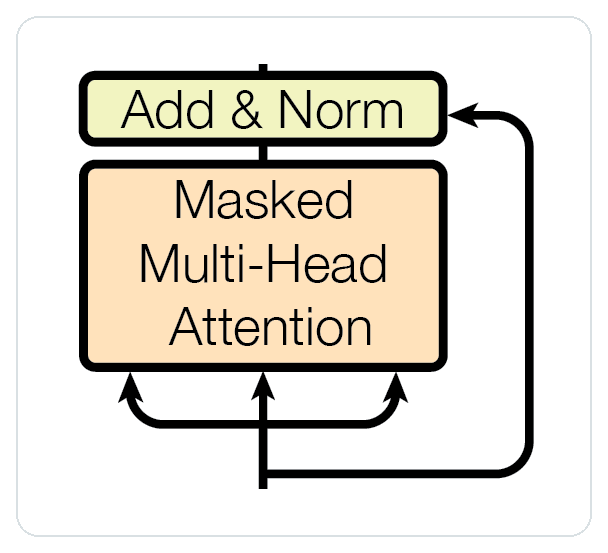
The first decoder sublayer uses masked multi-head self-attention. It resembles encoder attention, but a position cannot consult future tokens.
For <BOS> I drink coffee, the drink position can consult <BOS>, I, and itself, but not coffee.
Instead of deleting future tokens, a causal mask sets their attention scores to negative infinity (−∞) before softmax. Their resulting weights become 0. This preserves the matrix structure while preventing access to future answers.
Attention is followed by Add & Norm, as in the encoder.
Cross-attention
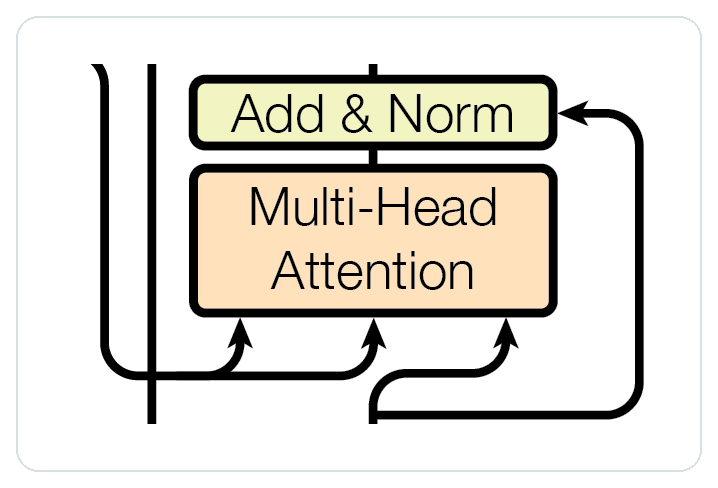
Cross-attention lets the decoder consult the source representations from the encoder.
Unlike self-attention, its queries and keys/values come from different streams: Q comes from the decoder; K and V come from the encoder.
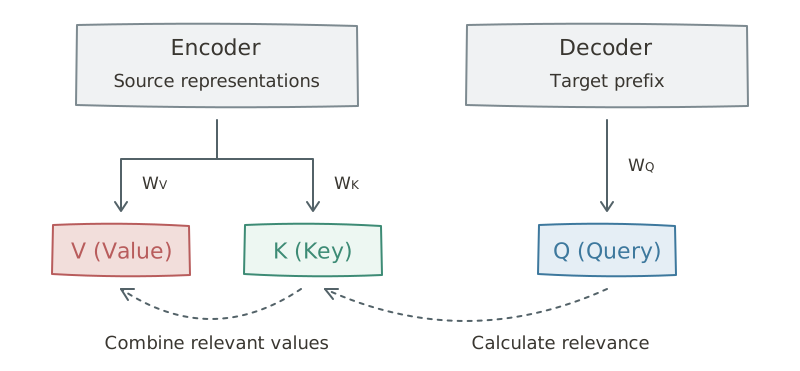
Learned projections create the vectors. Query-key comparisons determine which source information is useful for the translation so far. While predicting coffee, the decoder might place a high weight on the source token Kaffee.
Another Add & Norm and the FFN complete the remaining processing, using the same basic principles as the encoder.
Predicting the next token
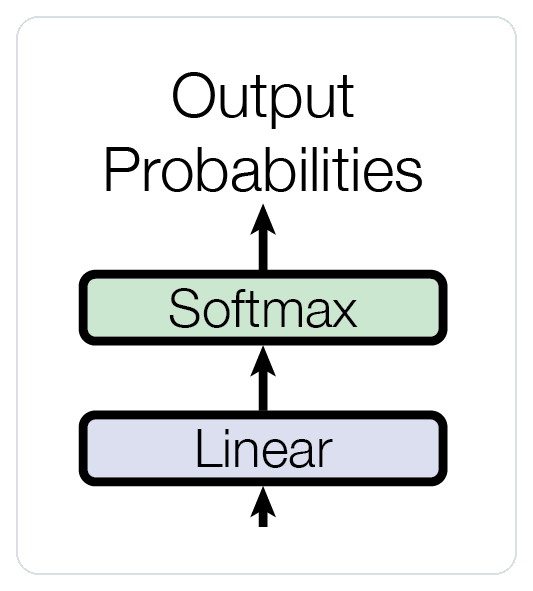
The final decoder representation at each position predicts the next token. A linear layer produces one logit per vocabulary item.
For a 37,000-token vocabulary, it produces 37,000 scores: perhaps coffee: 4.2, tea: 2.1, and apple: 0.7. These are not probabilities yet.
Softmax converts them to probabilities summing to 1. Given <BOS> I drink, coffee might receive a high probability.
At generation time, select a token from this distribution, append it to the decoder input, and repeat. This builds the translation one token at a time.
The transformer’s versatility
AI researcher and educator Andrej Karpathy discussed transformers in a Stanford CS25 lecture. He suggested describing the transformer as a general-purpose, efficient, optimizable computer rather than only an attention-based translation model.
The architecture is not limited to language. It has been adapted to images, speech, video, and robotics. Represent information as a suitable sequence, and the core ideas can apply beyond text.
Exercises
Decide whether each statement is True or False.
- Training decoder inputs begin with
<BOS>followed by target tokens. - Causal attention prevents a position from consulting later tokens.
- Cross-attention uses decoder queries and encoder keys and values.
- The linear layer directly outputs probabilities summing to
1. - Transformers can process other kinds of data represented as sequences.
Answers and explanations
- True — Inputs are shifted relative to prediction targets.
- True — Future attention scores are masked before softmax.
- True — This lets the decoder consult source information.
- False — The linear layer produces logits; softmax creates probabilities.
- True — Appropriate representations extend the architecture beyond language.